Product Features of Electric Heating Tubes
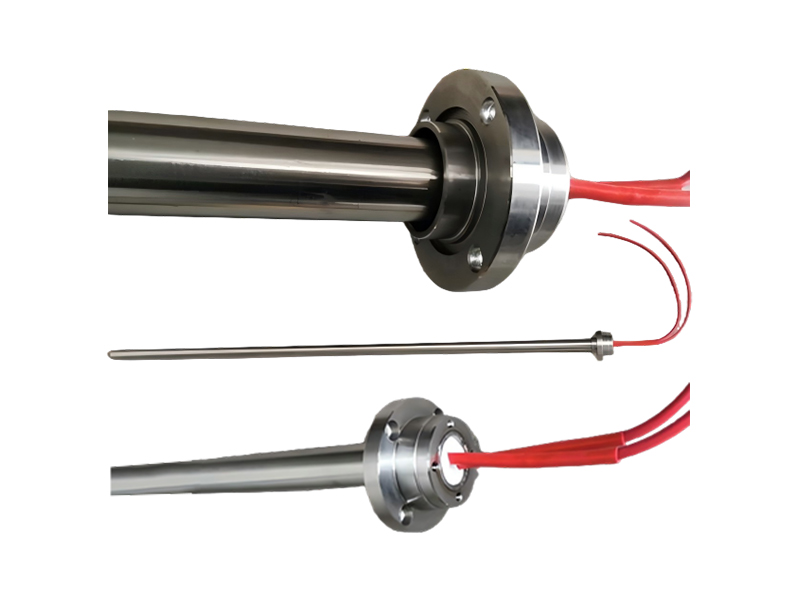
Stainless steel electric heating tubes consist of a metal tube as the outer shell, with a spiral electric heating alloy wire (nickel-chromium or iron-chromium-aluminum alloy) uniformly distributed along the central axis inside the tube. The gap is filled and compacted with magnesium oxide sand that has good insulation and thermal conductivity properties, and both ends of the tube are sealed with silicone or ceramic. Stainless steel electric heating tubes are electrical components specifically designed to convert electrical energy into heat. Due to their low cost, convenient use, easy installation, and pollution-free operation, they are widely used in various heating applications. Stainless steel electric heating tubes have a long service life, with a standard design life of over 10,000 hours.
Voltage can be designed from 12V to 660V.
Single-unit power rating: 50W to 20KW.
Available materials: 10# iron, T4 copper, 1Cr18Ni9Ti stainless steel, titanium (Ti), etc.
Available configurations: U-type, W-type (M-type), custom shapes, finned electric heating tubes, and explosion-proof electric heating tubes.
Material Requirements for Electric Heating Tubes
Among the factors affecting the quality of stainless steel electric heating tubes, the quality of raw materials plays a critical role.
Proper selection of raw materials is a prerequisite for ensuring the quality of electric heating tubes.
Tube material selection criteria: Temperature resistance and corrosion resistance.
Resistance wire selection: Cr20Ni80 (nickel-chromium alloy).
Magnesium oxide powder selection: Industrial-grade magnesium oxide powder.
Sealing material selection: Silicone oil + 704 sealant.
Applications of Electric Heating Tubes – U-Type Electric Heating Tubes
Compact size with high power output: The heater internally utilizes bundled tubular heating elements, with each bundled tubular element achieving a maximum power of up to 5000KW.
Fast thermal response, high temperature control precision, and high overall thermal efficiency.
Wide application range and strong adaptability: This circulation heater is suitable for both explosion-proof and standard environments, with explosion-proof ratings up to Class B and Class C, and pressure resistance up to 10MPa. The cylinder can be installed vertically or horizontally according to user requirements.
High heating temperature: The maximum designed operating temperature of this heater can reach 850°C, which is unattainable by conventional heat exchangers.
Fully automated control: Through the heater's circuit design, automatic control of parameters such as outlet temperature, pressure, and flow rate can be conveniently achieved. It can also be networked with computers for human-machine interface interaction.
Long service life and high reliability: The heater is manufactured using special electric heating materials, with reasonable power load design and multiple protection mechanisms, significantly enhancing both safety and service life.
Stainless steel electric heating tubes consist of a metal tube as the outer shell, with a spiral electric heating alloy wire (nickel-chromium or iron-chromium-aluminum alloy) uniformly distributed along the central axis inside the tube. The gap is filled and compacted with magnesium oxide sand that provides good insulation and thermal conductivity, and both ends are sealed with silicone or ceramic. This metal-sheathed heating element can be used to heat air, metal molds, and various liquids. High-temperature resistance wires are evenly distributed inside seamless stainless steel tubes, and the gaps are densely filled with crystalline magnesium oxide powder that offers excellent thermal conductivity and insulation. This structure is not only advanced and highly efficient but also provides uniform heating. When current passes through the high-temperature resistance wire, the generated heat diffuses through the crystalline magnesium oxide powder to the metal tube surface, and is then transferred to the object or air being heated, achieving the heating purpose.




 Home
Home
