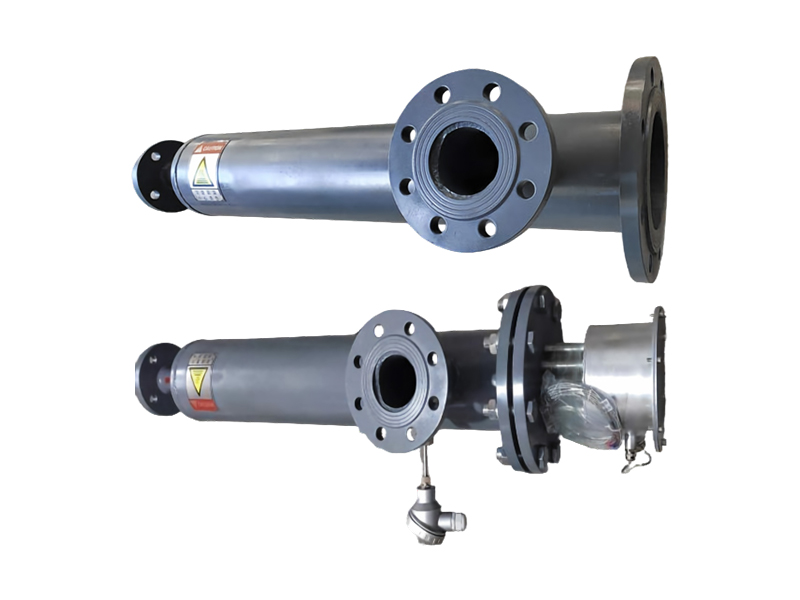
Pipeline electric heater is mainly an electric heating device that heats the medium by converting electricity into thermal energy. Stainless steel electric heating tubes are used as heating elements, and multiple guide plates are installed inside the product to guide the residence time of the medium in the inner cavity, so as to fully and uniformly heat the medium and improve the heat exchange rate. The internal high-temperature voltage system of the pipeline electric heater is composed of metal tubes. During operation, the high-temperature circulation system has magnesium aluminum oxide with good insulation and thermal conductivity inside. The two ends of the pipe mouth are sealed with silicone ceramic. The structure is not only advanced, but also has excellent heating effect, making it an energy-saving and environmentally friendly pipeline electric heater.
2、 Application areas and heating range
The pipeline electric heater can heat the medium from the initial temperature to the desired temperature, up to 850 ℃. It has been widely applied in many scientific research and production laboratories such as aerospace, weapons industry, chemical industry, and higher education institutions. Specially suitable for automatic temperature control and high flow high-temperature combined systems and accessory testing, the heating medium of the product is non-conductive, non combustible, non explosive, non corrosive chemically, and the heated space heats up quickly (controllable).
Pipeline electric heaters have a wide range of applications and can be divided into nitrogen heaters and air heaters based on the type of gas being heated, both of which can be referred to as pipeline gas heaters.
3、 Technical characteristics of pipeline electric heater
1. It can heat the medium to a very high temperature, up to 800 ℃, while the shell temperature is only around 50 ℃;
2. High efficiency: up to 0.9 or above; 3. The heating and cooling rates are fast, up to 10 ℃/S, and the adjustment process is fast and stable. There will be no phenomenon of temperature leading or lagging of the controlled medium, resulting in unstable control temperature drift, suitable for automatic control;
4. Good mechanical performance: Because its heating element is made of specially made alloy material, it has better mechanical performance and strength than any heating element under the impact of high-pressure air flow. This is more advantageous for systems and accessory tests that require long-term continuous air heating;




 Home
Home
